A New Breed of MeerKAT
Sightings of meerkats in the Northern Cape aren’t uncommon. Standing upright on their hind legs, twitching their noses in the air, meerkats keep a close eye on everything that surrounds them – their long, horizontal pupils give them a wide range of visions without forcing them to swivel their heads and their excellent eyesight allows them to spot danger more than 300m away.
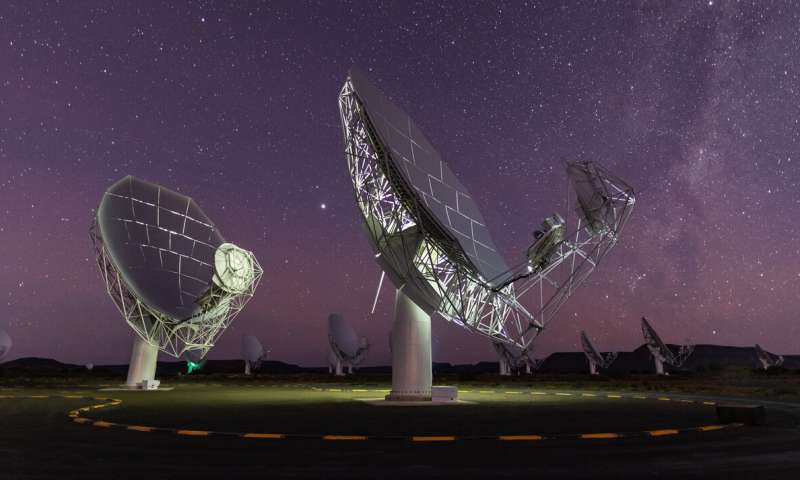
There’s a new sentry in the Northern Cape, with far-better eyesight – and its attentions are fixed on the heavens, rather than the landscape. The MeerKAT project, a 64 antenna array radio telescope, that will be integrated into the first phase of the international Square Kilometre Array (SKA) radio telescope installation, is taking shape 90km north-west of Carnarvon. A seven-array radio telescope, called KAT-7 (Karoo Array Telescope), served as a precursor to MeerKAT (More KAT) are complete and have already contributed significant scientific observations.
Phased Approach
The first phase of SKA will provide international scientists more than one million square metres of collecting area when it is complete, some time around 2023. The budget for phase 1 of the project has been capped at 650 million Euro, with the cost for the second and final phase, yet to be established. The SKA will form part of a network of thousands of radio telescopes, in three configurations, which will allow astronomers to monitor the sky in amazing detail, and also scan the entire sky many thousands of times faster than any other system currently in operation. The SKA telescope, co-located in Africa and Australia, will exceed the resolution of the famous Hubble Space Telescope by a factor of 50.
Drawing pictures of space with radio waves may sound like science-fiction, but it’s something scientists have been doing for years – though never on the scale that SKA will offer. Many cosmic sources emit radio signals – which sound a lot like the white noise between radio stations for those of us old enough to remember twiddling dials to find our favourite station. Highly-sensitive radio telescopes can detect these very weak radio signals from outer space, which are then processed by computers to deliver images of celestial objects. The larger the area the antennas occupy, the better the resolution of the image they’ll produce. Scientists will use the SKA to help us understand how the universe evolved, how stars and galaxies form and change and what ‘dark matter’ really is. “Once completed, the SKA will generate data at a rate more than 10 times today’s global Internet traffic,” says SKA Communications Manager Lorenzo Raynard. “The SKA telescope will be powerful enough to detect very faint radio signals emitted by cosmic sources billions of light years away from Earth, those signals emitted in the first billion years of the Universe (more than 13 billion years ago) when the first galaxies and stars started forming”.
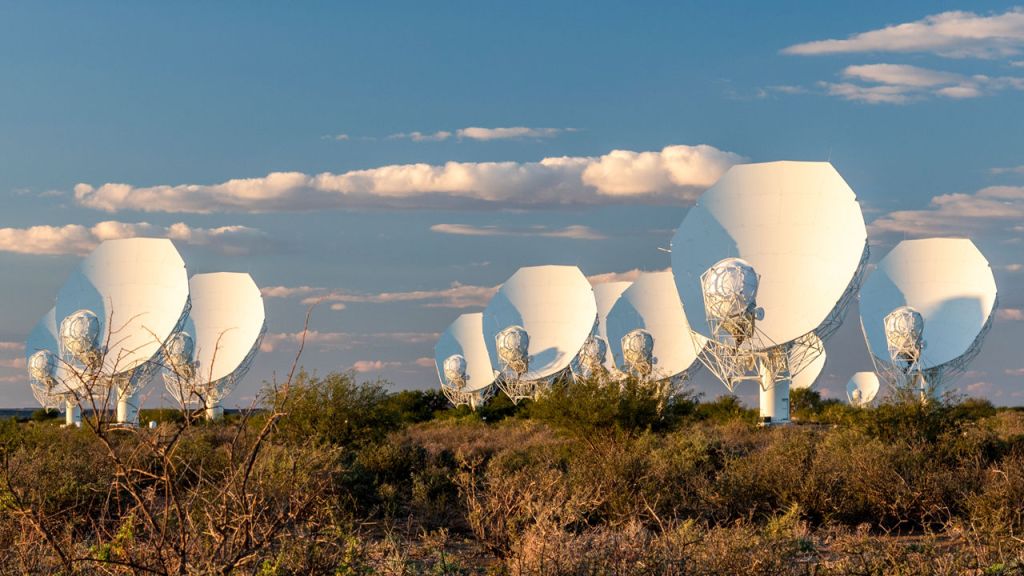
“We have 15 antennas installed on site and we are well on our way to meet the milestone to have 16 commissioned antennas – ready to start collecting data – by the end of June this year,” says Raynard. MeerKAT will eventually become part of a larger network called SKA1_MID, which will see a total of 197 dishes dotted across the Northern Cape landscape, some spread over distances as far as 150km. Eventually, thousands of SKA antenna dishes will be built on sites across South Africa as well as in eight African partner countries: Botswana, Ghana, Kenya, Madagascar, Mauritius, Mozambique, Namibia and Zambia. The complementary system in Western Australia will be composed of 125 000 low-frequency antennas.
World-Leading Tech
According to Raynard, the technology being developed for MeerKAT is cutting-edge and the project is creating a large group of young scientists and engineers with world-class expertise in the technologies which will be crucial in the next 10 – 20 years, such as very fast computing, very fast data transport, large networks of sensors, software radios and imaging algorithms. “Since 2005, the African SKA Human Capital Development Programme has awarded more than 700 grants for studies in astronomy and engineering, from undergraduate to post-doctoral level, while also investing in training programmes for technicians,” says Raynard. “Astronomy courses are being taught as a result of the SKA Africa project in Kenya, Mozambique, Madagascar and Mauritius (which has had a radio telescope for many years) and are soon to start in other countries.”
Thanks to the scale of the project, the continent as a whole will benefit, becoming a sought-after international science destination. “Over the next few decades, many top scientists and research students will come here to do cutting-edge science. The SKA will collect and process vast amounts of data and will stimulate cutting-edge advances in high-performance computing,” says Raynard. “This mega-project is therefore an ideal platform to excite young people about a career in science, engineering and technology, and to deliver skills that will be in demand in the global knowledge economy of the future”. For the next ten to twelve years, job opportunities will be created by the building of and support services to MeerKAT and the SKA itself. Following that, the running and maintenance of the SKA will create jobs for the next 50 years – never mind the obvious boost to studies in mathematics, engineering and astrophysics at local universities.
Growth Potential
The local impact of SKA and MeerKAT extends beyond the intellectual – local infrastructure is receiving a massive boost, too. 14 000 hectares of land has been sourced from two farmers in the area and the main access road between the Carnarvon-Williston provincial road has been significantly upgraded, employing over 120 local workers who have all received training in construction. Local power infrastructure has been significantly upgraded, as has local data access, thanks to the need for optical fibre lines. The project has opted to implement a self-built grid power scheme, to help save on capital costs. Once the grid power system is completed, it will be handed back to Eskom to operate and maintain.
“The array’s configuration – the way the antennas are placed on the ground – has a significant impact on what kind of science one can perform with the instrument,” explains Dr Jasper Horrell, general manager for science computing and innovation at SKA SA. “Putting the dishes close together is good for sensitivity to large, extended structures in the sky, or searching for pulsars. Having dishes further apart provides for high resolution, for instance being able to separate out very small structures. In addition, one wants to create a ‘well-behaved’ imaging beam, by carefully designing the overall distribution of antennas and ensuring sensitivity to a range of sizes of objects of potential interest.”
The Nuts & Bolts
SKA1_MID is configured to include a significant closely-packed core, plus antennas extending out to a radius of 4km. “The configuration for a general-purpose telescope such as MeerKAT is ultimately a compromise, and designed to support a wide range of science,” Horrell adds. Some of the fantastically-named projects which have already been allocated time on MeerKAT include LADUMA (Looking at the Distant Universe with the MeerKAT Array – an ultra-deep survey of neutral hydrogen gas in the early universe); MESMER (MeerKAT Search for Molecules in the Epoch of Re-ionisation, which will eventually use the X-band receivers of MeerKAT to study the first luminous objects in the Universe by searching for emission from their carbon monoxide lines) and ThunderKAT (The Hunt for Dynamic and Explosive Radio Transients with MeerKAT) – including gamma-ray bursts, X-ray binaries and tidal disruption events, novae and supernovae, plus new types of transients radio sources, through commensal and pointed observations. I’m sure you know exactly what they mean…
*A version of this article appeared in khuluma in April 2016.
Categories: Tech
 wineoclock