SA’s Own Super-Agent
The eye-watering amounts of money involved in football these days has inevitably shifted the game into new territory, with many football stars seeming to struggle to split their focus between the job they’re paid to do on the field, and the commercial opportunities outside it. With an entire career able to be decided by one vicious tackle or defined by one well-taken opportunity – under intense media and public scrutiny – the pressure on the modern footballer is immense.
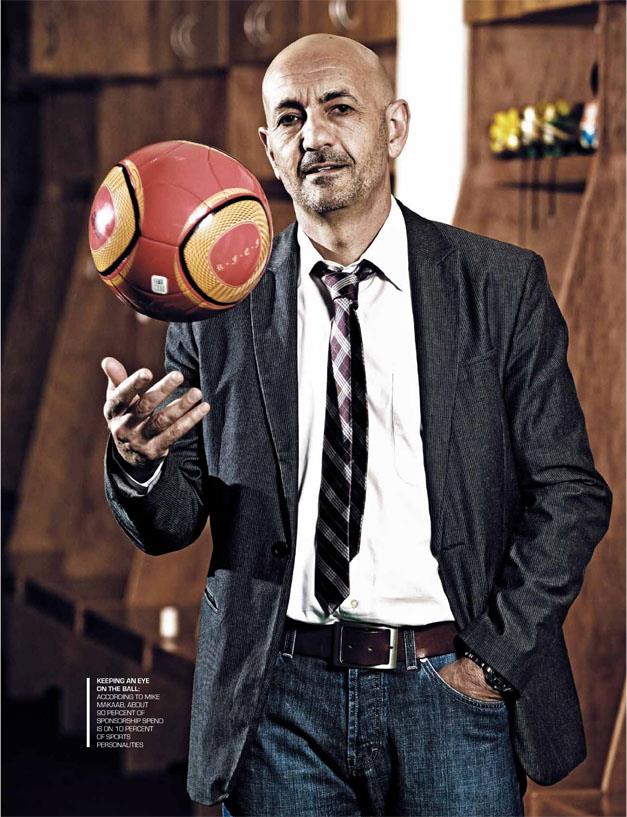
Prosport International MD Mike Makaab has been involved in amateur and professional football since 1984. In 1995 he joined Orlando Pirates as Technical Manager and then Chief Coach, guiding them to wins in the Iwisa Spectacular and Sparletta Challenge Cup and led them to victory in the African Champions League – they remain the only Southern Hemisphere club to achieve that feat. A stint at Amazulu followed, before he was eventually appointed as Managing Director at Prosport International in 1998 and became the country’s first FIFA-accredited Football Agent in 2001.
Since then, he and his team have placed close to two hundred African-based players in leagues across Europe and Asia. “I was blessed to have coached at the top level in this country for five years. In that time, I learnt a great deal about how professional footballers think, what motivates them, the challenges they face in their daily lives, the difficulty they have to transition from their playing days to their post-playing period and – most importantly – I have the knowledge of being able to advise professionally, given the practical experience I gathered during my coaching tenure,” he says.
While the common misconception about agents is that they’re often seen as brokers, who opportunistically do a deal, collect the commission and leave the player to fend for themselves, Makaab says a professional agent – and agency – offers a long-term partnership to its clients with 360-degree service. “At Prosport, we manage contract negotiation, sponsorship sourcing and endorsements, financial planning and tax consultation through our association with a number of experts in this field, and career guidance including ‘life after sport’ programmes”. A good agent, says Makaab, is a one with good knowledge of the industry, a strong global network, who is hardworking, enthusiastic, and professional, but above all has the inherent qualities of compassion and integrity, which he says are vital in an industry which at times lacks ethical behaviour, loyalty and sincerity.
Since his qualification as a FIFA-accredited agent, the governing body has done away with the concept in favour of decentralising the responsibility to the football associations affiliated to it. “This led to the birth of ‘intermediaries’. Each country’s association is responsible for rules and regulations pertaining to Football Intermediaries, as long as these do not conflict with the basic ones as stipulated by FIFA. In South Africa, this means that there is no longer a requirement for ‘agents’ to be licensed and the barrier to entry into the industry has become easier – with varying degrees of success,” he says.
Makaab is of the opinion that the amount of money at stake in modern football has principally created a massive gap between the “have’s” and “don’t haves”. “In all of the major leagues in Europe, in particular the clubs that have strong financial backing are light years ahead of the opposition. It’s not only money that creates success, but it surely plays a vital role in the process. This means that there are two very definitive markets in our business: one at the highest level where all the big role-players operate and the other where most of the global agencies compete. It has changed the dynamic of the industry”.
He says that he always encourages his clients to be professional in the way they address their contractual obligations. “A contract is there to be honoured, on both sides. It is common knowledge that if a club is unhappy with a player or vice versa, then ultimately a premature end to the contract is inevitable – in most instances,” he says. “This has nothing to do with power, it is the logical result to any relationship that does not work. I want to emphasise that in any industry if the intention of both parties to an agreement is not to honour the agreement, then paperwork only serves to determine and guide how the relationship ends: it is not the ‘glue’ that keeps the relationship together”.
One of his most enduring professional relationships is with the evergreen Siyabonga ‘Bhele’ Nomvethe, who returned to the professional game on a short-term contract with Uthongathi at the age of 42, last season. Quizzed about whether another local player will ever match the veteran’s longevity, Makaab won’t rule it out. “For any professional sportsperson to have unusual longevity in their career requires a number of ingredients in the mix, not least of all a slice of good luck when it comes to injuries and a lifestyle totally dedicated to their profession, both on and off the field,” he says. “Great footballers are born of a combination of talent, great attitude, determination, being willing to put in the extra hours in the gym and on the field, and a laser focus on the supposed ‘smaller things’: nutrition, sleep, lifestyle and so forth”.
Despite being involved in so many international transfers, he believes there are a number of reasons behind why more talented South African footballers haven’t made a name for themselves in the bigger leagues, where so many other African players thrive. “Firstly, we live in an amazing country where the lifestyle is comparable to most other great environments. Secondly, the local transfer market is vibrant, with the top clubs willing and able to pay big transfer fees to their counterparts to secure the right talent. This inflates the value of players and makes it difficult for European clubs to justify paying high transfer fees for a player who is not proven in the European arena,” he says. “Added to this is the fact that Africans (as is the case in most other countries) cannot move to Europe until they reach the age of eighteen, which prevents them from being exposed to the culture of European football at a younger age, which is vital for their development”.
With such an extensive background in coaching and managing the careers of players, Makaab has a keen eye for talent – so who does he think is South Africa’s ‘next big thing’? “It would be unfair for me to single out any player in particular, but keep your eyes on SuperSport United youngster, Sipho Mbule. If he keeps his feet on the ground and focuses all his energy on his career, he has incredible potential”.
Categories: Profiles
 wineoclock