Channeling Sports…
Sports fans take for granted the opportunity to watch their favourite team playing on the opposite side of the planet, from the comfort of their lounge. Feet up, replica kit on and braai stoked in the background, very little thought is paid to the technology behind bringing you a live Super Rugby match in HD, from a venue almost 12 time zones into the future.
At any given time, nearly 70 people are working at ungodly hours to bring you a Super Rugby match – and no, a significant proportion of them aren’t responsible for Naas’ hair & makeup.
On The Ground
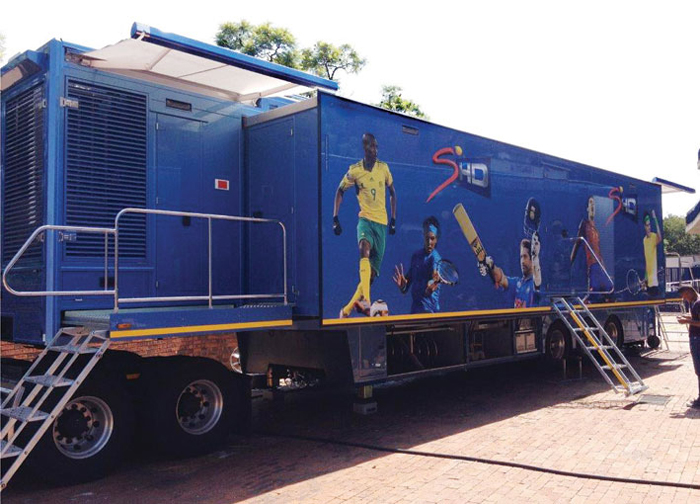
For a typical Super Rugby game in South Africa, between 35 and 50 people will be at the stadium, making sure pictures get to your TV. Apart from three multi-million Rand ‘Scanners’ – Outside Broadcast Vans – there are also 18 cameras focussed on the action. ‘We have fourteen manned cameras surrounding the field of play to cover every angle, along with two super-slo-mo cameras to capture tight decisions, and two ‘coach cams’, says SuperSport’s Executive Producer for Rugby, Louwrens Rensburg. ‘For bigger games, we’ll add a jib (the camera on the end of a long arm which provides sweeping images of the action) or a few more cameras. If we host a final on home soil, we’ll really push the boat out and add extra cameras and even a helicopter for aerial shots,’ he says. ‘We also have UltraMotion cameras which capture super-fine details at 1000 frames per second (as opposed to the regular +- 30) and are trialling 4k cameras, which capture images at four times the quality of current HD cameras’. One of the Scanners hosts a full production suite, with screens for the feed from each camera, and an audio suite where all the sound feeds are mixed together to provide the optimal combination of crowd noise, on-field audio and comments from the referee, to viewers. The other truck generally houses all the equipment, while the third is where the two generators sit – in the event that Eskom have one of their regular moments, the show will go on, uninterrupted.
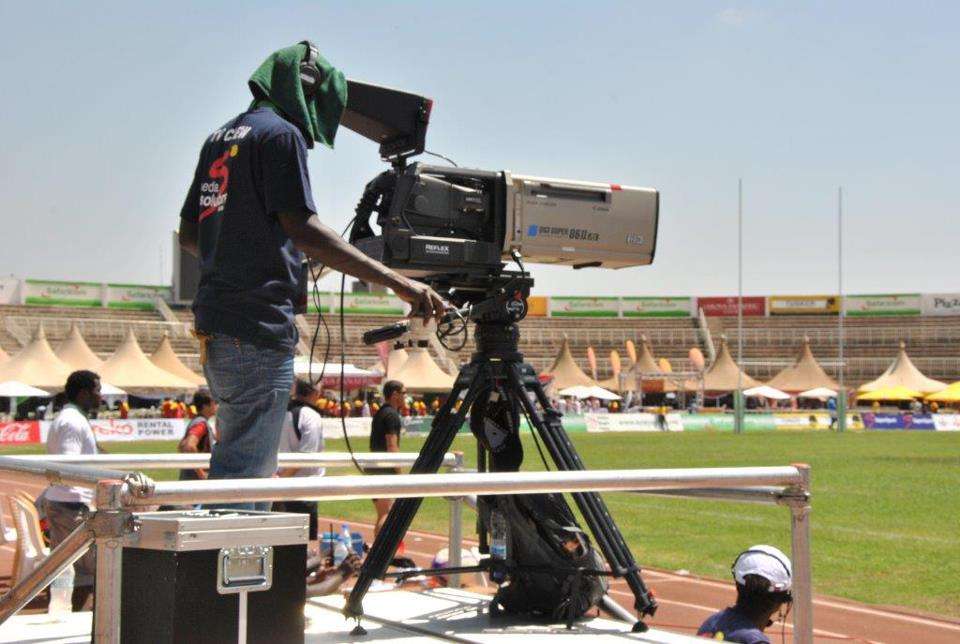
A lot of other innovations, like the ‘Spider Cam’ that whizzes along above the field of play on a network of cables, are available locally but have to be used carefully. ‘We’re looking at the ‘Ref Cam’ which viewers saw on the Springbok end of year tour in 2014, but aren’t happy with the current quality. If we can find a way to make the pictures from that camera look as good as those from our regular cameras, we’ll consider introducing it as part of our broadcast package,’ says Rensburg.
For games in Australia and New Zealand, SuperSport rely on images beamed in by broadcast partners Fox Sports and Sky New Zealand – helping the local broadcaster cover between 42 and 45 games per Super Rugby season, in all. ‘The feed arrives live at the Randburg studios and the local team add flavour in the form of customised graphics and commercialisation,’ says SuperSport’s Head of Production, Alvin Naicker. ‘We take the English commentary feed from them as well, and add our own Afrikaans and Xhosa options – South Africa is the only place in the world where sport is broadcast with three language options’. Broadcast standards are agreed upon at an annual meeting between the three Super Rugby broadcasters, meaning that parameters are set and a high level of quality is maintained.
Up In The Air
Aside from the camera operators on the ground, there is a contingent of behind-the-scenes engineers, led by a producer who looks after the storyline of the broadcast, and a director who calls the shots to deliver the quality coverage that fans are now used to being spoiled with.
‘The director works with his team to put together the best possible feed, which is then sent from the broadcast venue, to a satellite thousands of kilometres above the earth,’ says Naicker. ‘From there, the feed is sent back down to our studios in Randburg, where the audio and video quality are constantly assessed. Then, that curated feed is sent back up to a satellite, and then down again, to viewers’ TV’s via satellite dishes and set-top boxes’. The delay between the live action on the field and the picture on your TV screen, after a journey of tens of thousands of kilometres? ‘About four and a half to five seconds,’ says Naicker.
Talking Heads
One of SuperSport’s key selling points is the calibre of analysts on the panel to dissect games. Watching Nick Mallet, John Mitchell, Naas Botha and company offer expert insight into on-pitch happenings adds immeasurable value to the coverage – but spare a thought for the behind-the-scenes team in the studios, who support them.
Around 20 more people are involved at the SuperSport studio in Randburg, to help Ashwin Willemse play with his favourite touch-screen toy and lay on graphic-enhanced representations of the game’s key moments. In addition to the production team at the stadium, there’s another director leading the studio team, squeezing the highlights into the ten-minute halftime break and giving the analysts access to every element they need. All of these things need to be coordinated amidst the excitement of a tense match, incorporating ad breaks and myriad other elements.
Naicker says that South Africa is blessed with some of the most talented production people on the planet – and also some of the hardest-working. ‘Our Outside Broadcast teams generally arrive at the stadium in two waves: the technical team will be there two days before the event to set up all the cameras, lights and kilometres of cable. Then, the production team arrives the day before and does a complete run-through, testing all the elements so that everything is fine-tuned for the broadcast itself,’ he says. ‘Remember that the bulk of sporting events happen on the weekend and we have teams covering multiple sporting codes across the country – it really is quite an operation. Look at last year’s South Africa vs West Indies Cricket series – the team that covered that started travelling when the first match was broadcast from SuperSport Park before Christmas, and they were on the road until the end of the final ODI at the end of January’.
Staying Afloat and Ahead Of The Game
With all these elements to juggle, things can often get a little hairy – but that’s where the team’s expertise comes in. ‘We always have a Plan B and a Plan C,’ says Naicker. ‘Our team is so experienced that they’re generally prepared for just about any eventuality, because they’ve seen it all before. We try not to make mistakes – but if we do, we ensure that we never make the same mistake twice. I like it when my Chief Engineer is just sitting watching the game – it means his team has already done all the hard work to get things right’.
Innovation-wise, SuperSport has already taken advantage of just about every new broadcast opportunity out there. ‘The broadcast world has matured, and so has our business,’ says Naicker. ‘Everyone around the world just seems to be taking a breath and waiting to see what the next big thing will be. Our job is then to innovate with the current technology and keep pushing its limits. We focus on providing the best experts and analysis – you can only put so many cameras on an event, after all!’
*This article was originally published in TFG Tech.
Categories: Tech
 wineoclock
It’s amazing how much technology goes into bringing us these exciting rugby matches.
LikeLike