The Island With Everything
“Close your eyes and don’t open them until I tell you to,” says tour guide Nicolas Cyprien. We left Réunion’s capital, Saint-Denis, about two hours ago, heading south-east, winding first along the coast and then, inland.
Over the last few kilometres, we’ve climbed steeply and the tamarind trees have given way to fynbos-type scrub with oddly-grey stems and luminous green foliage. The edges of the tarred road, narrowing now, are tinged with red dust. “Keep them closed, it’s just a few hundred metres more,” says Nicolas. The car swings through a few hairpin turns and comes to a stop. Nicolas switches the engine off and silence descends. “Ok, open your eyes”.
Nothing prepares you for your first sight of the inside of a volcanic caldera. We’re perched on the lip of a hill, which descends into a valley, ringed by black peaks. The soil on the floor of the valley below doesn’t look like dirt – it’s red, grey and black. The road snakes down to the floor and then arrows through the valley as though drawn by the hand of someone scared of scarring the desolate landscape. I step out of the car and onto the grey sand beside the road – which turns out to be tiny fragments of rock and stone. Everything around me is volcanic rock, straight from the centre of the earth. A handful crumbles away to the red dust which has lined the road for the last few kilometres.
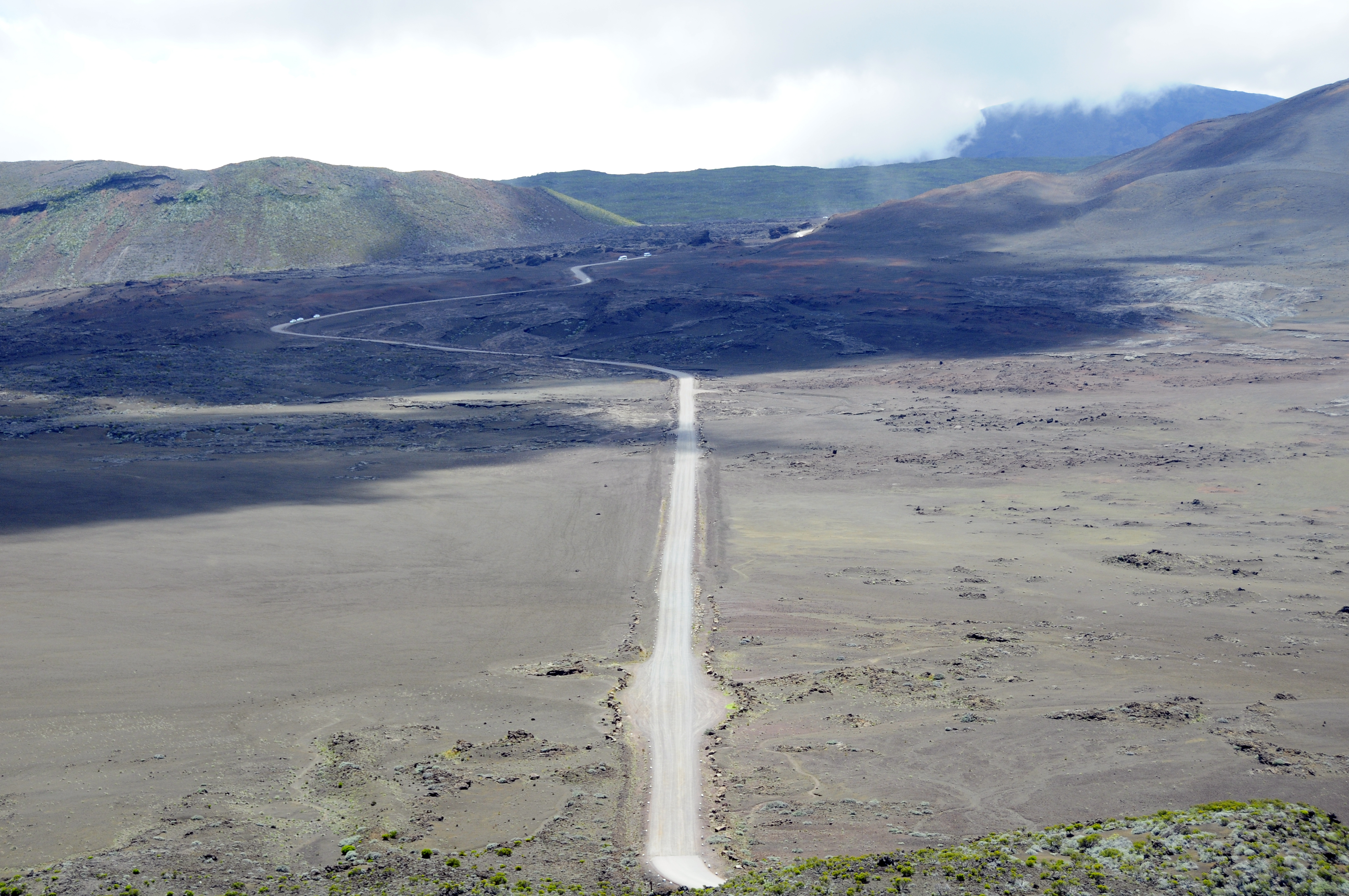
We follow the twists and turns down the side of the hill and onto the arrow-straight road. The bumps in the landscape seen from atop it are actually giant rocks that dwarf our rental car. The volcano itself is still kilometres away, but everything around us was spat from its mouth. The road curves eventually, twisting and climbing fractionally again, opening out into a cul-de-sac filled with cars. A short walk and I’m on the edge of another valley. On the floor are swathes of multi-coloured dried lava – before me, Réunion’s active volcano, Piton de la Fournaise. It doesn’t look that high from the edge of the caldera, until I squint through my camera at the tiny coloured dots on the floor of the valley and trailing up the volcano’s slope. They’re trekking tourists – and the scale of the volcano gives me momentary vertigo.
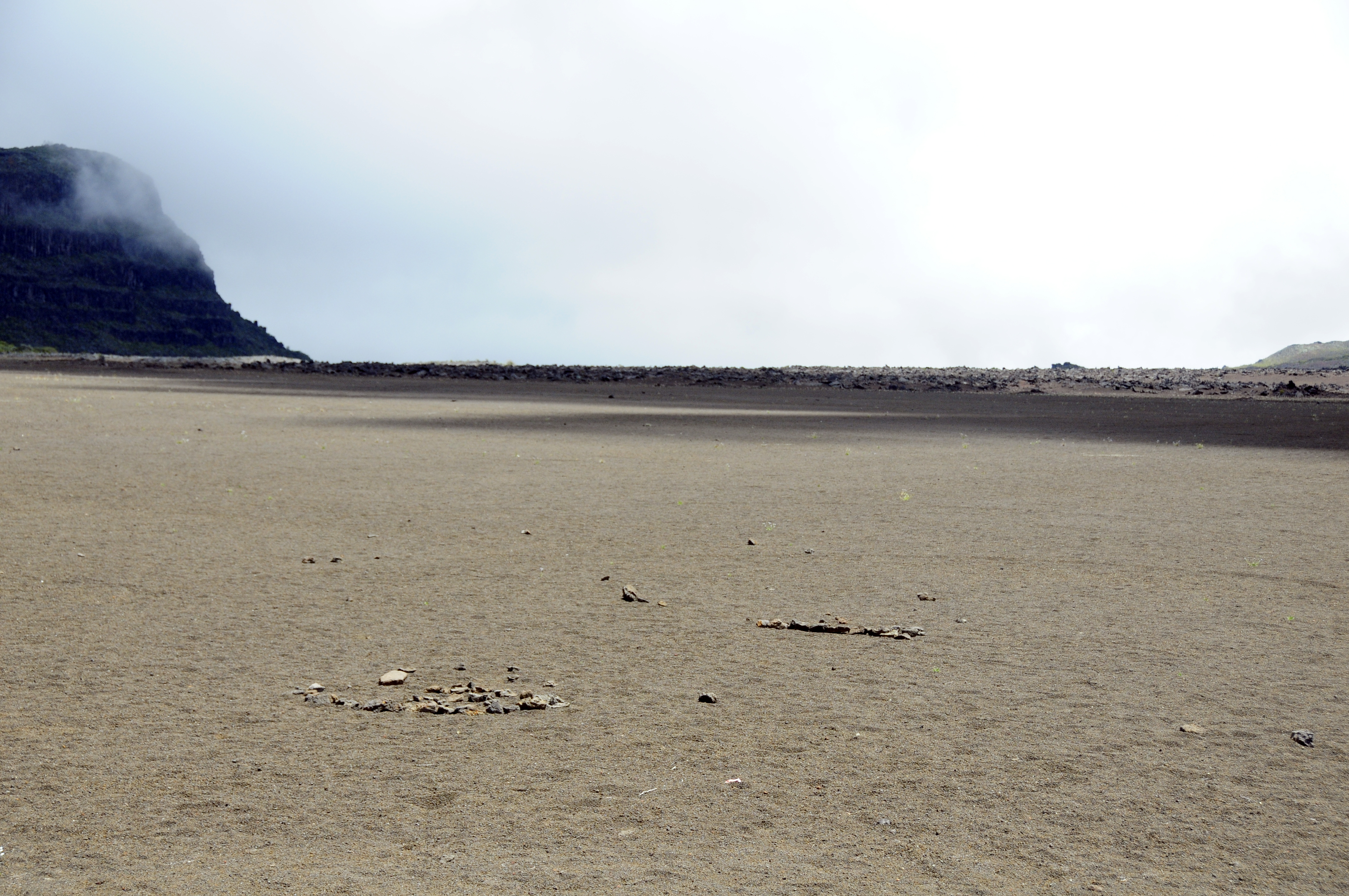
Standing over 2600m above sea level, Piton de le Fournaise is still active, and is the outlet of the ‘hot spot’ in the earth’s crust on top of which the Indian Ocean island of Réunion sits. It last erupted in August 2015, spewing rocks into the sky and down its slopes and bathing the southern half of the island in an orange glow in the evenings. The island itself is slowly inching away from the hot spot which birthed it, an inexorable slip across the sea, which will eventually sever the red-hot umbilical cord and send it off into the ocean on its own, millimetres at a time.
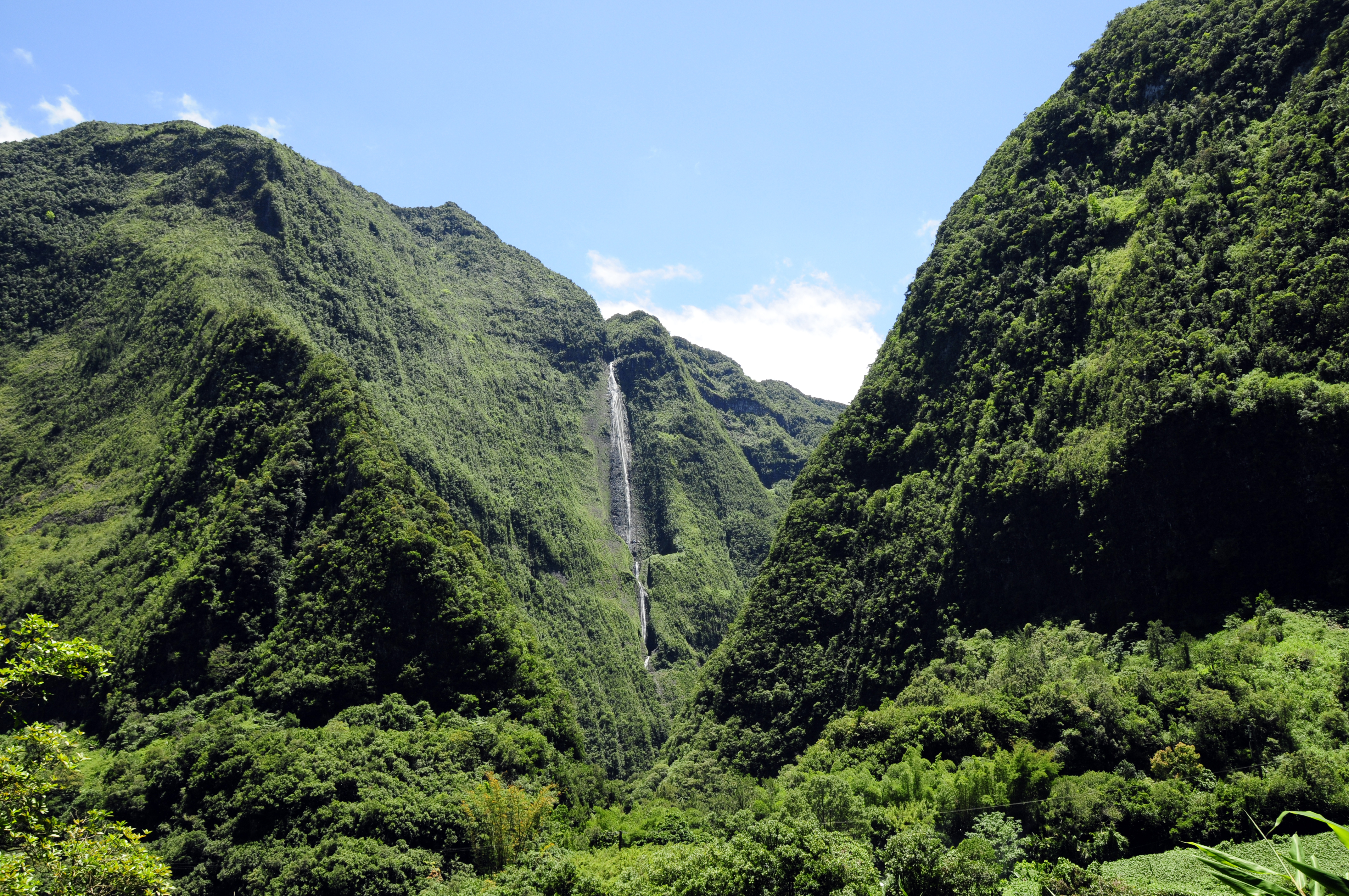
Réunion, 175km south-west of Mauritius, slopes down towards its coast from the dizzyingly-high interior, dominated by Piton de La Fournaise and the even higher, but inactive, Piton des Neiges – the ‘snow peak’. Inland, the volcanic soils outside of the calderas have given the island a verdant, green heart, with waterfalls trailing into deep rivers. To the north is the busy capital, Saint-Denis. On the west coast, Saint-Gilles and Saint-Leu are home to all-inclusive package hotels and some of the world’s best surfing and paragliding spots. The east is rainier, with clouds trapped by the high peaks creating the perfect conditions for the establishment of sugar cane plantations, which are a staple of the island’s economy. The south is rocky and relatively uninhabited – the geography of the Piton de la Fournaise means that whenever it erupts, lava flows down the southern slope and into the sea, erasing whatever life has sprung up there since the last lava flow.
To many South Africans, Réunion is just a pretty island they fly over en route to Mauritius’ all-inclusive resorts, but as an ‘overseas department’ of France, the island has strong links to Europe, and as a result, a much higher profile in countries ten hours’ flight to the north, than in the country 4 hours’ flight to the west. The ‘French connection’ gives the tiny island advantages in terms of culture, food, language and impressive first-world infrastructure – which, when coupled with everything you’d expect from an island with year-round sunshine and the warm Indian Ocean lapping its shores, makes it an attractive holiday destination. For South Africans, the bad news is that we need to spend Euro once we’re there, though the good news is that one travel obstacle – the costly and admin-intensive Schengen Visa – isn’t required for a visit.
Even in winter, the temperature on the island rarely drops below 20 degrees, and as much as the sun may feel ever-present, Réunion also holds world records for rainfall volume. The mix of volanic soil, ample rainfall and searing sunshine – coupled with the soaring elevations and deep valleys of the interior – make it one of the most lush and diverse places on the planet. There are 220 micro-climates on the 2500km2 island, which means that crops as diverse as strawberries, grapes, coffee beans, vanilla and sugar cane thrive there.
Réunion is packed with adventure opportunities, offering an array of extreme sporting possibilities. I found myself surfing thermals, 800m above the emerald coast of Saint-Leu on a tandem paraglide, swooping over a sea turtle sanctuary before landing on the beach. It’s also a renowned surf spot, with some of the world’s greatest surfers sampling its famous ‘left wave’ during a number of ASP World Tour events held there. Recently-installed shark nets have eased fears over shark attacks and opened up the west coast to family-friendly tourism. For the brave, Cirque du Mafate in the interior offers a host of world-class kloofing, hiking and abseiling opportunities.
In the interior, small villages are cossetted in the folds of the cirques – many of them inaccessible by road and offering authentic island-life experiences for avid hikers. Hell-Bourg, in the heart of the Cirque du Salazie, is a charming, authentic Creole town with beautiful views – officially recognised as one of France’s most-beautiful villages.
If You Go
Réunion’s official carrier, Air Austral flies to Roland Garros Airport in Saint-Denis from Johannesburg on Sundays and Thursdays, with prices starting at around R5 500 per person in economy class. Air Mauritius has daily flights from Johannesburg (and multiple weekly flights from Cape Town and Durban) to Réunion via Mauritius, from around R10 000 per person. There are also daily flights between Paris and Réunion on Air France.
In Saint Denis, try hotels like the Mercure Creolia Saint-Denis La Reunion from R2 300 per room, per night or the quaint but stylish Hotel Le Juliette Dodu from R2 200 for a standard room. In the vibier Saint-Gilles, stay at the glamorous Lux Saint-Gilles from R3 400 per night on all-inclusive packages. Hotels are almost non-existent in the interior, but there are some authentic listings opening up on Airbnb.
For more about Réunion, visit the Réunion Tourism website.
*This feature appeared in Sunday Times Travel Weekly on 22 May 2016.
Categories: Travel
 wineoclock
Well written 🙂 Paints a lovely picture of the quaint Island.
LikeLike
Thanks Elize!
LikeLike